Blue Yonder
A thousand dashboards and 800 tables became ten semantic models. Analysis that took a team four days returns in about ninety seconds.
The Universal Semantic Layer
Enterprise AI is only as accurate as the semantic layer beneath it.
Trusted by teams at:
Turns a metric into SQL and computes it in your warehouse, then serves the same number to everything that asks.
Reads a question in plain language and resolves it to one metric before anything runs.
Builds and maintains the semantic model with AI as a partner.
Scores your answers against a gold standard and names the ones that failed.
Warehouse permissions carry through, enforced in one place. Definitions ship like code.

Connect any LLM, agent or BI tool to the warehouse you already invested in, with one governed definition of every metric.
A thousand dashboards and 800 tables became ten semantic models. Analysis that took a team four days returns in about ninety seconds.
Three thousand KPIs and more than a thousand users on one semantic layer, now feeding agentic AI.
Chose AtScale as the engine inside Semantic Views, and invested.
See AtScale in Action
Try a Self-Guided TourLLMs and agents cannot safely infer joins, metric definitions, or time intelligence from raw schemas.
Comps are up for merchandising. Flat for finance. Guidance goes out Thursday.
Regulators don’t accept “Copilot said so.”
On time for the carrier. Late for the customer.
Is a suspended line a churned customer?
Discharged in June. Admitted in July. Count as a readmission?
Plant 4 has the best uptime. Plant 4 counts changeovers as running. You just moved the capex.
Is a reopened claim a new claim?
One password. Four households. Wall Street gets one number.
Three platforms took credit for one sale. Three of them invoiced you.
Universal by Design
Bring a metric your team argues about and watch it come back the same way twice.
Awards
AtScale named a Leader and Fast Mover in the 2025 GigaOm Radar Report for Semantic Layers and Metrics Stores.


AtScale is a universal semantic layer platform that defines business metrics once and computes them where your data already lives, so every BI tool, AI agent, and application gets the same answer. Its AI Computation Engine (ACE) turns each request into optimized SQL and runs it in your cloud data warehouse, such as Snowflake, Databricks, or Google BigQuery.
Your data stays in your warehouse. AtScale is also the engine inside Snowflake Semantic Views. Learn about the universal semantic layer.
A semantic layer is a business-friendly layer between raw data and the people and AI tools that query it. It defines metrics like revenue, margin, and churn once, along with their logic, hierarchies, and access rules, so every query uses the same definition.
A universal semantic layer, like AtScale, works across multiple warehouses, BI tools, and AI agents instead of inside a single platform.
AtScale solves three problems: inconsistent metrics, inaccurate AI answers, and rising warehouse costs. When BI and AI tools query raw tables, each one interprets “revenue” differently, so the same question returns different numbers.
AtScale gives every tool one governed definition of each metric, computes it once, and reuses the result. That keeps numbers consistent across Power BI, Excel, Tableau, and AI agents, and cuts the compute each query consumes.
AtScale makes AI agents more accurate by giving them governed business definitions to query instead of raw tables. When an agent asks for “revenue,” AtScale Ava (Ask, Verify, Answer) determines which revenue it means, such as recognized revenue, bookings, or ARR, before any query runs.
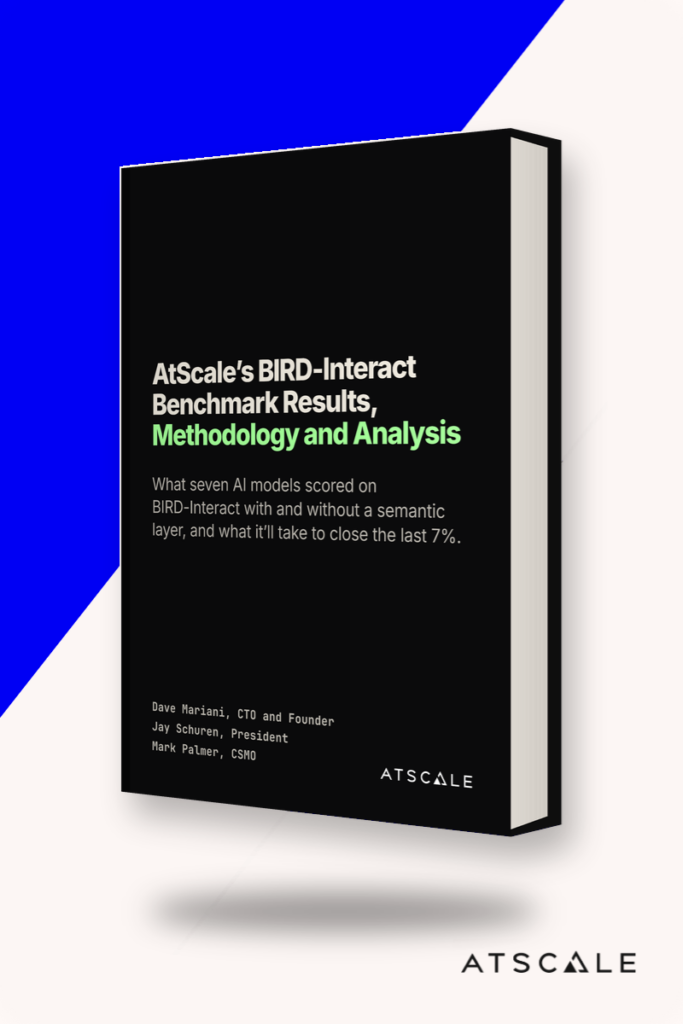
ACE then computes the answer from that definition, so every result is consistent and traceable to its metric logic. On BIRD-Interact, a public benchmark of real enterprise questions, AI without a semantic layer answers about one question in five correctly. [Adding AtScale’s semantic layer raised accuracy by up to 140% — publish once results are final, with a link to the write-up.]
AI clients including Claude, ChatGPT, and Cursor connect to AtScale through MCP (Model Context Protocol). Because definitions live in AtScale, you can swap models, warehouses, or agents without rebuilding business logic. Agentic AI glossary.

AtScale cuts warehouse and AI query costs by computing each metric once and reusing the result instead of rescanning raw tables for every question. ACE builds and maintains aggregate tables inside your warehouse and routes queries to them automatically.
In a Tier 1 bank benchmark, five representative queries cost $17.93 through an unguided warehouse path and $0.0008 through AtScale.
AtScale sits between your data platform and the tools that query it. You define metrics, hierarchies, and relationships once in a semantic model, and every tool reads that same definition.
When a request arrives, from an AI agent in plain language or from a BI tool like Power BI, Ava identifies the metric and ACE turns the request into optimized SQL. ACE runs that SQL in your cloud data warehouse and returns the result to Excel, Tableau, Power BI, Python, or the agent.
AtScale is built for enterprise data and analytics teams, BI leaders, and teams building AI agents on company data. Chief Data Officers use it to get one trusted set of numbers; BI teams use it to serve Power BI, Excel, and Tableau; AI teams use it so agents answer business questions correctly. AtScale is an enterprise semantic layer platform for every industry.
AtScale runs on Snowflake, Databricks, Google BigQuery, Amazon Redshift, Microsoft Azure Synapse, PostgreSQL, Cloudera, and InterSystems. It serves Power BI, Excel, Tableau, Looker, Qlik, ThoughtSpot, MicroStrategy, and Google Sheets.
Data scientists connect through Python (Jupyter, Pandas, and PySpark), and AI clients like Claude, ChatGPT, and Cursor connect through MCP. See all integrations.
Yes. AtScale is the engine inside Snowflake Semantic Views and extends those definitions to tools like Power BI and Excel. On Databricks, AtScale works with Unity Catalog / metric views.
Because AtScale is universal, one semantic model can serve multiple warehouses so metric definitions don’t change when data moves between platforms.
AtScale computes business metrics at query time and serves the same answer across every warehouse, AI model, and BI tool. A data catalog documents where data lives and what it means. dbt prepares and transforms data before anyone queries it. A warehouse’s built-in semantic features work only inside that one platform.
AtScale complements all three: it reads the models dbt builds, uses the context catalogs hold, and powers Snowflake Semantic Views.
Bring a metric your team argues about and watch it come back the same way twice.