USE CASES / CONVERSATIONAL ANALYTICS
Conversational analytics: ask in plain language, get the right number.
People ask questions in Claude, Copilot or ChatGPT. AtScale works out which metric they mean and computes it the same way finance does.
Conversational analytics doesn’t work unless people trust the answers. AtScale sits between the AI tools your team already uses and your data platform. It resolves each question to one certified metric and computes the answer from its definition. People can see where the number came from, so they don’t have to take it on faith.
The challenge
People ask short, vague questions, and the AI doesn’t ask what they meant before it picks one.
The AI writes new SQL for each question, and it won’t always get the math right.
Different tools give different answers to the same question.
What you get
Every answer comes from one certified definition, in every AI and BI tool.
People see which metric produced the number, and only the data they’re allowed to see.
THE CHALLENGE
Two out of five questions people ask are ambiguous.
When researchers reviewed every question in KaggleDBQA, a benchmark built on real-world databases, they marked 41% as ambiguous (Floratou et al., CIDR 2024). In a later study, asking people to clarify an ambiguous question before running it raised accuracy from 42.5% to 92.5% (2025).
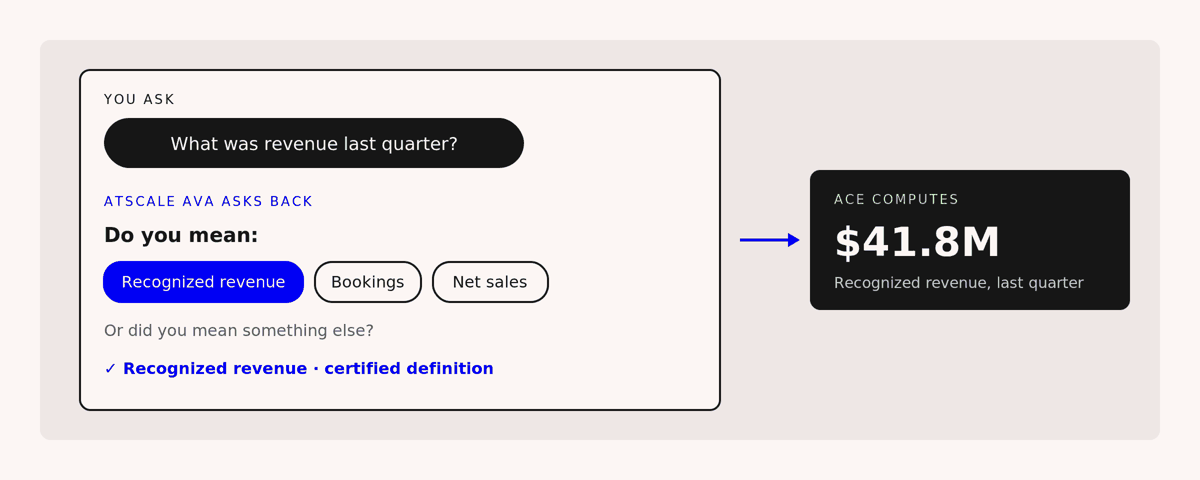
“What was revenue last quarter?” can mean bookings, recognized revenue, ARR or net sales, and they’re all different numbers. A model that picks one without asking can return an exact figure for a metric the person didn’t mean.
HOW IT WORKS
From a question in Claude to a number finance would sign off on.
Ava finds every metric in your semantic model that matches the word in the question, shows them side by side, and asks which one the person means before anything is computed. ACE then computes that metric in your data platform.
Say a regional finance manager asks Claude for gross margin in EMEA last quarter.
- Claude calls AtScale. It reaches the AtScale MCP server with the manager’s identity.
- Ava resolves the question. “Gross margin” maps to one certified metric, and “last quarter” maps to the fiscal calendar. If a term matches more than one metric, Ava asks which one the manager means.
- ACE computes it. ACE calculates gross margin from its definition and runs the SQL in your data platform, limited to the rows the manager is allowed to see.
- Claude answers. The number comes back with the metric it came from, and the exchange is logged.
- The answer becomes a rule. When someone clarifies a term, your team can approve that answer into the model, so the next person gets the right number and isn’t asked again.
WHERE PEOPLE ASK
The same answer in every tool your team uses.
| Where people ask | How it reaches AtScale |
|---|---|
| Claude, ChatGPT, Microsoft Copilot, Cursor | The AtScale MCP server, with Ava resolving each question |
| Excel and Power BI | Live over XMLA, with no extracts |
| Tableau, Looker and SQL tools | SQL over JDBC and ODBC |
| Notebooks and apps | Python and REST |
Row- and column-level security is defined once and applies the same way in every tool, so a manager asking in Claude sees the same regions they’d see in Excel.
THE PROOF
Asking first gets the BIRD-Interact answer right.
On BIRD-Interact, a simulated user asks for “a ranked list of stars in the galaxy.” Without AtScale, the model guesses alphabetical, then size, and runs out of budget. With AtScale, the system asks which ranking the user means, and one query gets it right. Across the benchmark, adding AtScale made an LLM twice as accurate. AtScale’s results are preliminary.
FAQ
Questions about conversational analytics.
Is this text-to-SQL?
No. The AI picks a certified metric, and ACE, the AI Computation Engine, writes and runs the SQL from its definition.
What happens when the AI can't tell what someone means?
Ava shows the matching metrics side by side and asks which one they mean before anything’s computed. Your team can approve that answer into the model, so the next person isn’t asked again.
Which AI tools can people use?
Claude, ChatGPT and Google Gemini connect through the AtScale MCP server, and so can any client that supports remote MCP servers. Excel and Power BI connect live over XMLA.
Can people see where a number came from?
Yes. Each answer comes back with the name of the metric that produced it, and the SQL is available for anyone who wants to check.
Will people see data they shouldn't?
No. Each person’s identity passes through to the data platform, and your access rules apply to every prompt.
Book a workshop.
The workshop takes thirty days from kickoff to results.
- Bring us your most controversial metric and the business questions your team and your agents ask about it every week.
- We benchmark your AI on them, with AtScale and without it.
- You keep the semantic model we built to run the test.